)
How it works
Find out more
)
Jan Brendel
Brand & Content Strategy Manager
Published
Updated
Rising and volatile electricity prices, external shocks that make planning difficult, increasing electrification across sectors, and growing decarbonization requirements are leading many companies to the same question: how can energy costs be stabilized in the long term? And which options are suitable for their specific use case?
In this context, one term often comes up: Corporate Power Purchase Agreement, or CPPA – essentially the “big sister” of the PPA. For many, it initially sounds like a specialized instrument for large corporations or portfolio managers who deal with corporate energy procurement every day. In reality, however, it’s based on a very fundamental principle: the direct, long-term procurement of electricity from renewable sources via a specific contract – and this can be suitable for any company, regardless of size or electricity demand.
Before evaluating whether this model makes sense for your own business, it’s worth taking a step back and examining the different options and structures within it.
In this article, we take a closer look at Corporate Power Purchase Agreements (short: CPPA) and their various sub-models. As feed-in tariffs decline and further regulatory changes are being discussed, PPAs are becoming increasingly important. We explain the advantages and disadvantages of each model and provide a solid foundation to help you make the right decisions about electricity procurement for your company and benefit from them in the long term.
In traditional electricity procurement, companies purchase power from an energy supplier. This is similar to the private sector: same principle, similar structures. Prices are based on the market and this market has become significantly more volatile in recent years.
There are several reasons for this:
The share of renewable energy is increasing rapidly and will continue to grow
Electricity production is becoming more weather-dependent (sun and wind)
Electricity demand is rising due to electrification in production, buildings, and fleets
This development means that electricity prices no longer remain constant but fluctuate significantly throughout the day and over longer periods, driven by supply and demand. When there is excess energy available, prices can even turn negative.
For companies, these fluctuations create a central problem: energy costs become difficult to calculate, even though they are crucial for many business models. External shocks and crises further increase this uncertainty.
In addition, requirements regarding the origin of electricity are becoming more stringent and increasingly anchored in law. For example, Germany’s Energy Efficiency Act (EnEfG) requires data centers to use 100 percent green electricity from 2027 onward. This is where CPPAs come into play as a key model for green electricity procurement.
Simply put, a Corporate PPA is an electricity supply contract, a specific type of agreement within the energy market. It is concluded between a company and an operator of one or more renewable energy assets such as solar, wind, or hydro, which may be distributed across Germany or the DACH region. It can be understood as a direct partnership between producer and consumer without involving a large energy supplier. In many cases, such CPPAs are also concluded with solar or wind parks located near the company’s site.
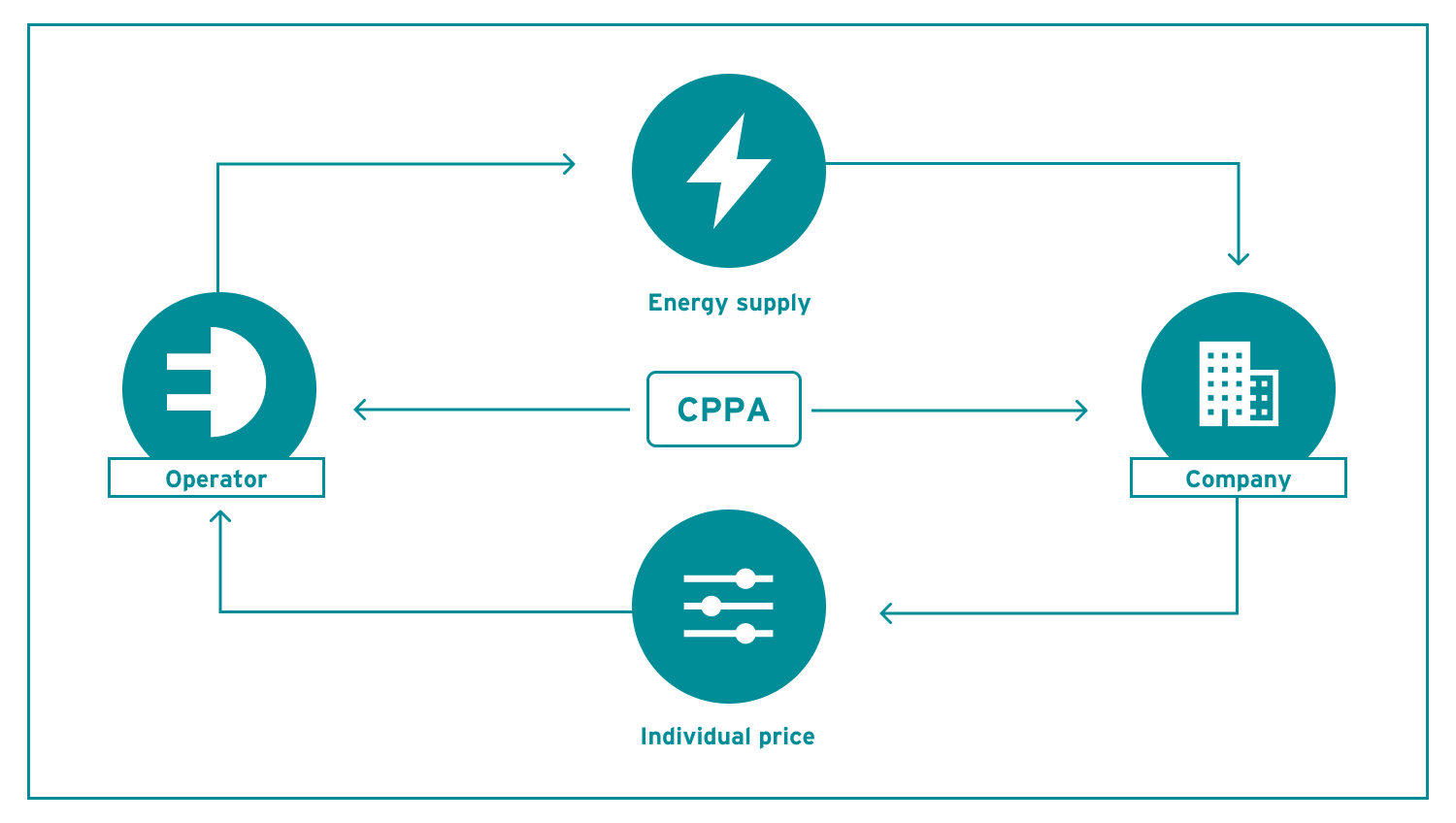
The key differences compared to traditional procurement are:
The electricity price or procurement method is agreed upon in advance for a defined period
The electricity comes directly from renewable generation assets and supports regional value creation
Companies gain predictability through long-term price guarantees without upfront investment in their own generation assets
Transparency regarding the origin of electricity is ensured through guarantees of origin (GoO)
In theory, the principle is simple. In practice, it becomes more complex when considering how and where electricity is actually generated, distributed, and consumed. The following sections take a closer look at how this works.
The central difference lies in the location of generation.
With an on-site PPA, electricity is generated directly at the company’s location, typically via a photovoltaic system on the roof or on vacant land or space at the site. The advantage lies in direct consumption without costly grid routing, which reduces additional costs such as grid fees.
With an off-site PPA, electricity comes from external installations, for example from solar assets within an energy producer’s portfolio. The electricity is allocated to the consumer on a balancing basis rather than through a direct physical connection. The main advantage here is scalability. Companies are no longer limited by the available space at one single site, and energy from multiple generation assets can be bundled and distributed efficiently.
In practice, particularly for high energy demand, the greatest benefit arises from combining both models. On-site generation covers part of the demand efficiently, while external installations provide additional volumes and stability, making it possible in theory to cover the entire electricity demand from renewable sources.
If demand exceeds the output of the producer, additional electricity can be purchased and supplied. The producer effectively becomes a decentralized energy provider combining multiple PPAs for the customer. For the company, nothing changes operationally. The agreed pricing or procurement structure remains in place, and additional electricity is also supplied with guarantees of origin. A detailed demand analysis defines how the total supply is composed.
In this context, the term residual electricity procurement is often used to describe the supply of additional electricity via off-site PPAs.
Green electricity procurement involves two relevant markets, the futures market and the spot market, both of which influence pricing.
|
Criterion |
Futures market |
Spot market |
|
Pricing |
Fixed price over a defined period |
Dynamic flexible price over a defined period |
|
Predictability |
High |
Lower |
|
Timing |
Purchased in advance |
Short-term (day-ahead or intraday) |
|
Risk |
No volatility |
Higher fluctuations |
|
Opportunity |
Limited |
Better use of low prices |
The spot market in Europe primarily operates via exchanges such as EPEX Spot. Electricity is traded here on a short-term basis, usually for the next day or within the same day. Prices are determined in fifteen-minute or hourly intervals and reflect real-time supply and demand.
The futures market works differently. Electricity is purchased for future delivery, often months or years in advance, typically at fixed prices.
In practice, combining both markets can create economic advantages. Part of the demand can be secured through the futures market, while the spot market is used to optimize procurement and take advantage of short-term price fluctuations.
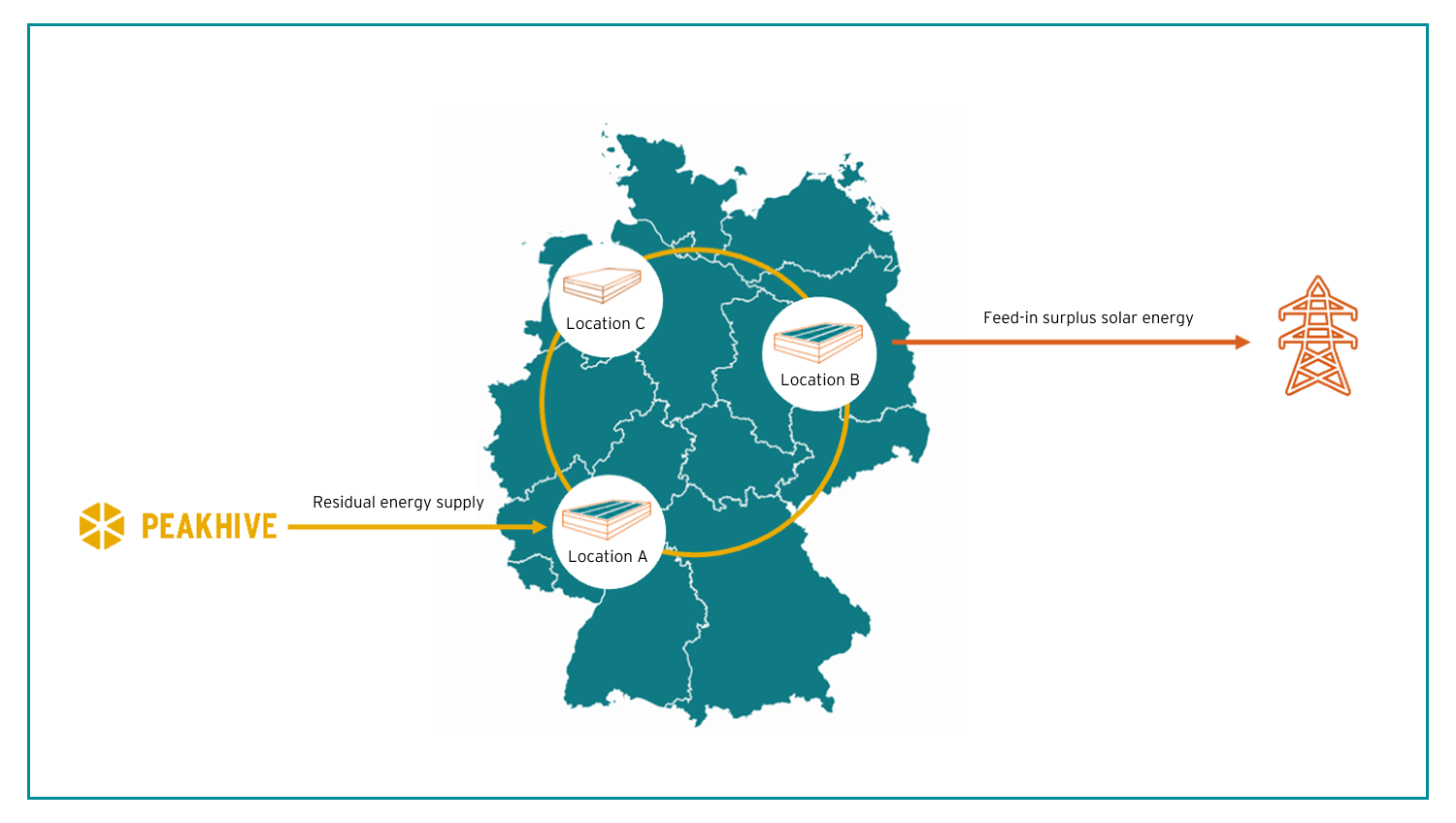
The greatest leverage of modern PPA models lies in their structure, particularly when multiple company locations are connected within a CPPA. A central concept in this context is the balancing group, which can be understood as a virtual account where electricity generation and consumption are balanced.
Within such a system, multiple locations are connected, enabling electricity to be used across sites.
This is what a balancing group could look like:
For example, one location may have a large photovoltaic system that produces electricity locally. If this site generates more electricity than it consumes, the surplus can be allocated to other locations within the balancing group. Instead of feeding excess energy into the grid and purchasing electricity elsewhere at higher prices, the system is optimized internally.
This creates clear economic advantages:
self-consumption rates increase
dependence on grid electricity decreases
overall electricity costs can be distributed more efficiently
This model forms the basis for scalable corporate PPAs. If total demand exceeds generation capacity, additional electricity can still be purchased via the market, either based on a fixed or dynamic electricity tariff as we already explained above.
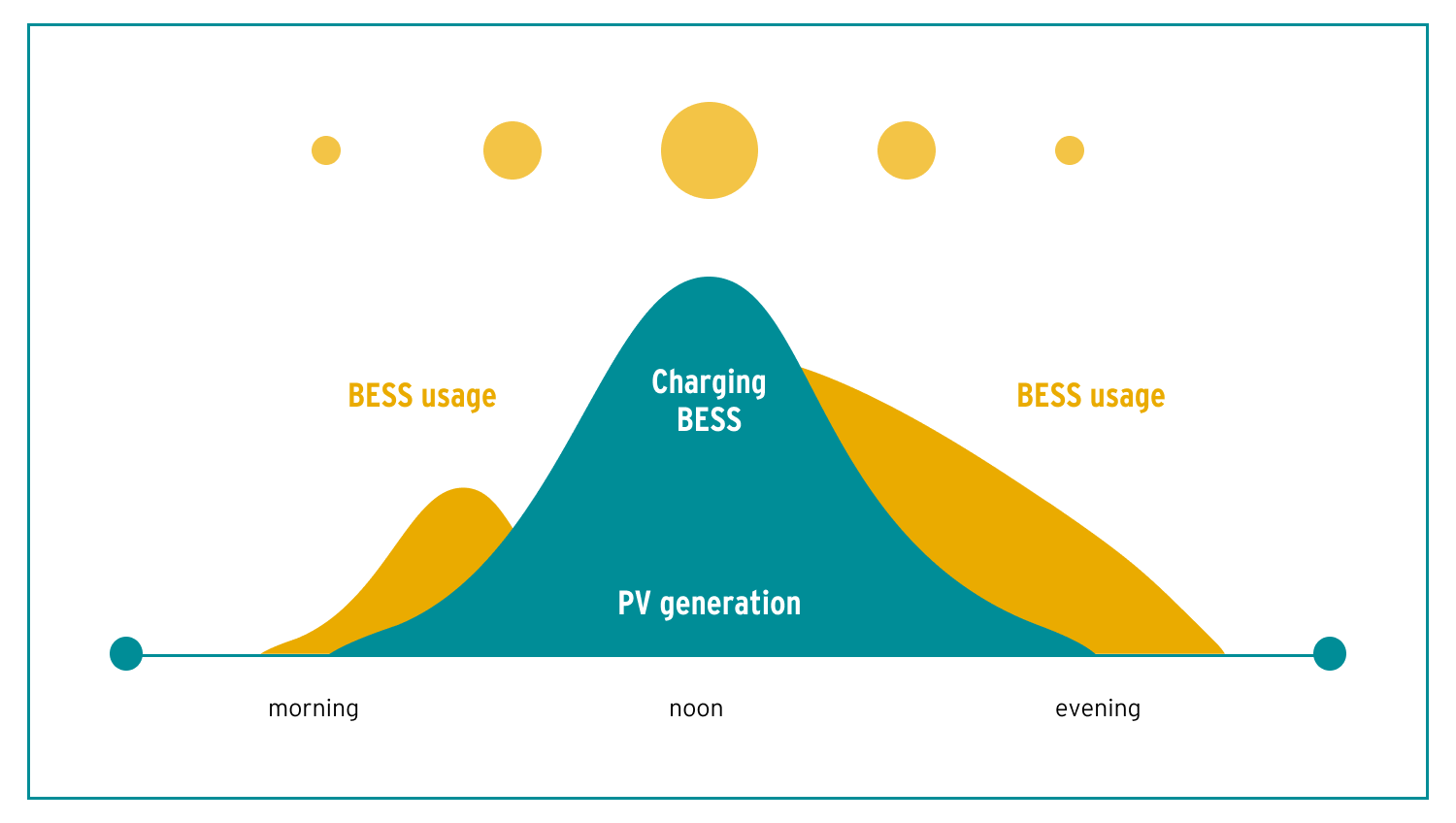
Battery storages (BESS) fundamentally change how electricity is used. They decouple generation and consumption over time and make flexibility economically viable.
When photovoltaic systems produce large amounts of electricity at midday, energy can be stored and used later. When electricity prices fluctuate significantly or generation does not align with consumption, battery storage systems provide a solution.
A recent PPA market analysis by dena highlights the direction of the market:
The share of solar power produced during periods of negative prices has increased significantly and is expected to continue rising
At the same time, achievable market values for photovoltaic electricity are declining
As a direct response, more and more projects are being combined with battery storage systems in so-called co-location setups to increase flexibility and stabilize revenues
The dynamics in the storage market itself are particularly strong, with the volume of storage contracts more than doubling within a year – according to dena.
To view this video, please activate the "External Media" category in our.
For companies in industry and commerce, this means that battery storages are becoming a central element of electricity procurement strategies. They enable several key advantages:
Use of low-price periods
Avoidance of price peaks
Reduction of load peaks
Lower grid fees through optimized usage
Better integration of photovoltaic energy into consumption patterns
Participation in energy trading
The overall trend clearly points toward integrated energy systems that combine generation, procurement, and flexibility, enabling companies to actively leverage market volatility.
To view this video, please activate the "External Media" category in our.
There are many different PPA types – often with different names for similar structures. For classification, an overview of the most common terms is sufficient:
Physical PPAs describe the actual delivery of electricity between producer and buyer – often easy to implement due to geographical proximity. In this case, an energy supplier acts as an intermediary.
Virtual PPAs, on the other hand, function financially: a price is hedged without physical electricity being delivered. The producer financially compensates the purchasing company by paying the difference between the agreed sales price and the actual market price at the time of production.
Sleeved PPAs involve an energy supplier who handles the operational processing between the producer and the purchasing company and ensures that the market process runs smoothly. The concluded contract between producer and buyer remains in place.
In addition, there are models with multiple buyers or sellers as well as different delivery methods. What matters most is how price, volume, and flexibility come together.
Corporate PPAs are not a niche instrument for large corporations but a structured procurement model that companies of all sizes can use to strategically manage energy. Their core value lies in the combination of price stability, transparency regarding electricity origin, and the ability to actively meet increasing decarbonization requirements.
Whether a CPPA makes sense depends less on company size and more on energy demand, willingness for long-term planning, and the ability to combine different models effectively. The model becomes particularly attractive when multiple locations, on-site generation, and flexible procurement strategies work together.
The real leverage, however, lies in intelligent system integration. Combining on-site and off-site structures, using battery storages strategically, and implementing a balancing group (where relevant) allows companies to actively turn market volatility into economic advantage.
In summary, a CPPA is not just an electricity supply contract but a building block for a stable, cost-efficient, and renewable-based energy supply. Companies that engage with these structures early gain planning security and a clear competitive advantage in a dynamic energy market.
)
LET'S TALK
You have questions about our PEAKHIVE solar offers or want to learn more about how to harness renewable energy as a business?
Just reach out. We are happy to discuss your individual needs and provide information on the topics that are important to you.
A Corporate Power Purchase Agreement (CPPA) is a long-term electricity supply contract between a company and an operator of renewable energy assets. The company sources electricity directly from photovoltaic or wind power under predefined conditions. The goal is to make energy costs predictable while simultaneously using green electricity.
Brand & Content Strategy Manager
Brand & Content Strategy Manager Jan Brendel creates versatile content on the topics of renewable energies, solar and photovoltaics at ENVIRIA. He has worked as a copywriter and author in various industries and has gained a deep understanding of the needs and requirements of companies over the years.
Among other things, he has written scientific papers in the industrial and manufacturing sectors (mechanical and plant engineering, logistics, etc.). His passion for music is at least as great as his passion for the energy transition of companies.
)
)
)
)
)
)
)
)
)
)
)
)
)
)
)
)